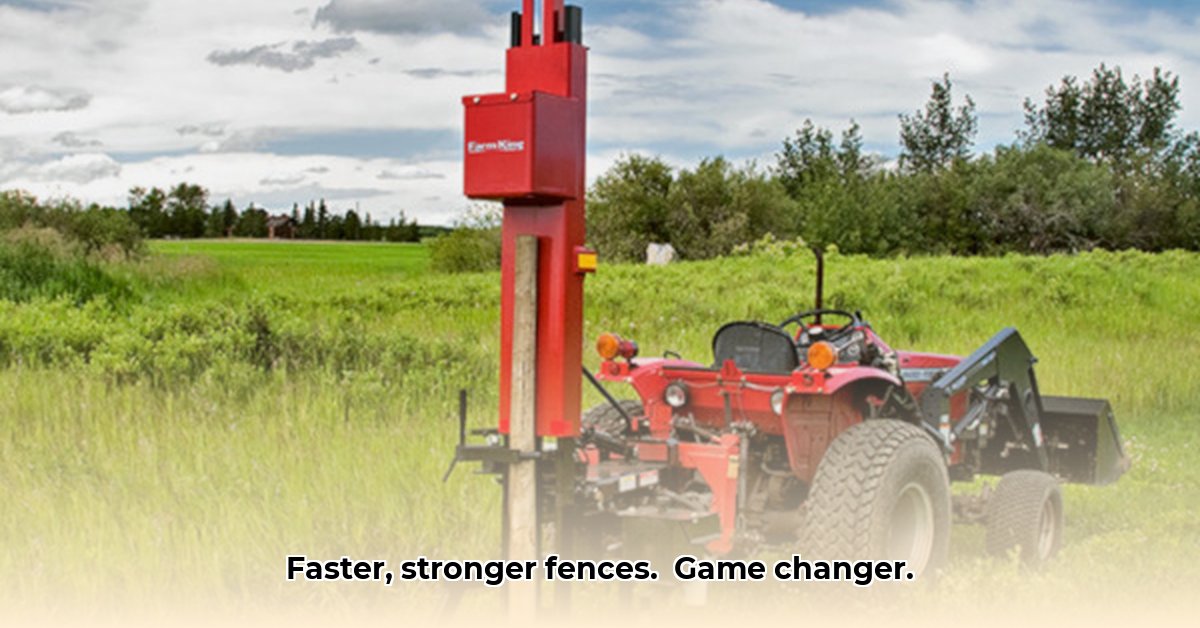
Thinking about streamlining your fence building process? Tractor-mounted post drivers offer significant time and labor savings, making them an attractive investment for sustainable farming practices. Farm King offers two models, the 1450 and the 2400, each catering to different needs and scales of operation. This guide helps you determine which model—or if either—is the right fit for your farm. For more information on tractor mounted post drivers, check out this helpful resource.
Farm King 1450 vs. Farm King 2400: Choosing the Right Post Driver
Selecting the optimal post driver depends heavily on your farm's size and fencing requirements. The Farm King 1450 presents a cost-effective solution for smaller farms with moderate fencing needs, while the Farm King 2400 is engineered for larger operations and contractors demanding higher capacity and mobility.
Farm King 1450: Efficiency for Smaller Farms
The 1450 is designed for integration with existing tractors, leveraging their power for efficient post driving. Its ease of use and relatively lower initial cost make it an attractive option for smaller farms or those with limited fencing projects. Is this compact model suitable for your farm's needs? Consider your annual post-driving requirements to make a sound investment.
Farm King 2400: Power and Versatility for Larger Scales
The 2400 model is built for larger-scale operations and contractors. Offering significantly higher power and capacity, it handles extensive fencing projects with ease. Its versatility is further enhanced by its trailer-mounted design, providing exceptional maneuverability across varied terrain. Could the significant increase in capacity justify the additional initial investment for your farm?
Detailed Specifications Comparison
| Feature | Farm King 1450 | Farm King 2400 |
|---|---|---|
| Ideal Farm Size | Smaller farms, limited fencing needs | Larger farms, extensive fencing needs, contractors |
| Power Source | Tractor's power take-off (PTO) | PTO or independent engine |
| Mounting Options | 3-Point Hitch | 3-Point Hitch, Skid Steer, Trailer Unit |
| Mobility | Limited to tractor mobility | High mobility, especially in trailer configuration |
| Initial Cost | Lower | Higher |
Step-by-Step Operational Guide
Regardless of the chosen model, prioritizing safety is paramount. Before operating, always conduct a thorough pre-operation check.
1. Pre-Operation Checklist: Inspect all components for damage, verify fluid levels (where applicable), and ensure secure connections. Familiarize yourself with all safety features and controls.
2. Post Preparation: Prepare posts beforehand, ensuring they are straight, correctly sized, and sharply pointed for efficient driving. Using a post-setting guide ensures consistency and uniformity.
3. Mounting and Attachment: Securely attach the post driver to your tractor (1450) or prepare the 2400 for operation according to the manufacturer's instructions. Double-check all connections before proceeding.
4. Post Driving Procedure: Engage the PTO (for 1450 or PTO-powered 2400) or start the engine (for engine-driven 2400). Carefully lower the driving mechanism, ensuring accurate post alignment. Engage the driving system and operate the machine smoothly and carefully.
5. Post-Operation Procedures: Always disengage the driving system before lifting the post. After completing the task, thoroughly clean and inspect the equipment.
Maintenance and Troubleshooting
Regular maintenance significantly extends the lifespan of your post driver. This includes checking fluid levels, lubricating moving parts, and regularly inspecting for any signs of wear or damage. Promptly address any issues identified. The owner's manual provides comprehensive troubleshooting guidance.
Cost-Effectiveness Analysis: Return on Investment
While the initial cost varies between models, the long-term savings in labor costs can be substantial, especially for larger projects. The 2400, despite its higher upfront cost, frequently proves more cost-effective per post for high-volume tasks due to increased speed and efficiency. Evaluate your specific fencing needs and usage frequency to determine the most economically viable choice.
Making the Right Choice: A Decision Matrix
Consider these key factors when selecting between the Farm King 1450 and 2400:
- Farm Size: The 1450 suits smaller operations; the 2400 handles larger scales.
- Terrain: The 2400's mobility is advantageous for varied terrain.
- Budget: The 1450 offers a lower initial investment.
- Project Volume: Frequent or large fencing projects benefit from the 2400's efficiency.
Remember, a sound investment in quality equipment minimizes downtime and maximizes long-term efficiency. Carefully assess your needs to make the most informed decision.